
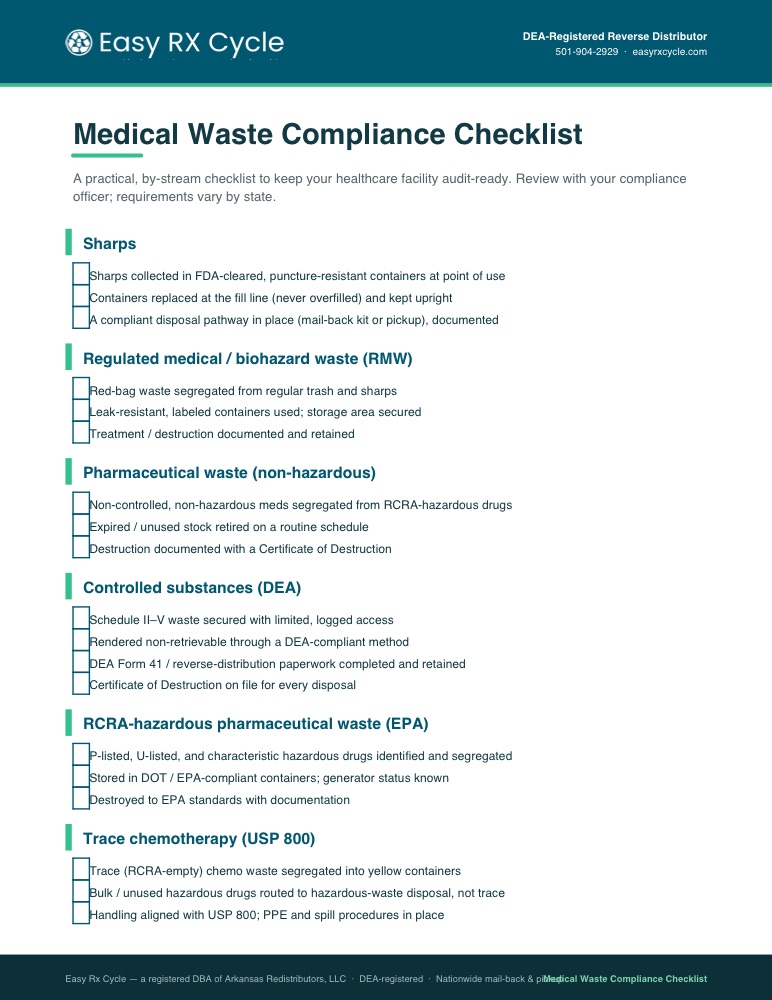
Medical Waste Compliance Checklist
A practical, by-stream checklist to keep your healthcare facility audit-ready — covering every regulated waste stream, plus training and documentation.
What’s inside
- Stream-by-stream checks: sharps, biohazard, pharmaceutical, controlled, RCRA, trace chemo
- Controlled-substance essentials: non-retrievable destruction, Form 41, Certificate of Destruction
- Training & documentation your inspectors look for
- Where one vendor can cover every stream you generate
Who it’s for: Practice managers, compliance officers, and anyone responsible for waste at a healthcare facility.
Why a By-Stream Checklist Keeps You Audit-Ready
Most citations don't come from one bad decision — they come from a stream nobody assigned an owner. Sharps, red-bag biohazard, non-hazardous pharmaceuticals, controlled substances, RCRA-hazardous drugs, and trace chemo each carry a different rule and a different destruction standard. When responsibility is vague, the overlooked stream is the one an inspector finds first. A written, by-stream checklist forces you to confirm that every category your facility generates is identified, segregated, labeled, containerized, and documented before anyone from OSHA, the EPA, the DEA, or your state health department ever walks the halls. It also turns compliance from tribal knowledge held by one long-tenured staffer into a repeatable process that survives turnover, new hires, and a busy day when the person who usually handles waste is out.
The Frameworks Each Line Item Maps To
A useful checklist ties every task back to its source rule so staff understand why the step exists. Sharps and regulated medical waste fall under OSHA's Bloodborne Pathogens Standard, 29 CFR 1910.1030, which requires puncture-resistant, labeled containers and a written exposure control plan. Controlled-substance destruction follows DEA 21 CFR 1317, with DEA Form 41 documenting non-retrievable destruction of Schedule I–V drugs. Hazardous pharmaceutical waste is governed by EPA RCRA, 40 CFR, including the Subpart P healthcare rule at 40 CFR 266, which bans sewering hazardous drugs. Hazardous and chemotherapy agents are handled under USP <800> practices, and anything shipped off-site for destruction must be packaged to DOT's 49 CFR using UN3291 for regulated medical waste. Naming the citation on each line removes the guesswork.
Segregation and Container Rules Inspectors Check
Segregation is where the checklist earns its keep, because streams that get mixed can rarely be un-mixed. Sharps belong in FDA-cleared, puncture-resistant containers placed at every point of use, replaced at the fill line, and never overfilled. Red-bag biohazard is reserved for items visibly saturated with blood or other potentially infectious material — over-classifying lightly soiled waste inflates cost, while under-classifying invites a violation. Hazardous drugs must be pulled out before anything reaches a general pharmaceutical bin, and controlled substances kept under secure, witnessed handling from the moment they're set aside. Confirm labels are legible, lids close, and containers sit upright and out of public reach. An inspector reads the containers first and the paperwork second; both need to agree.
Documentation and the Certificate of Destruction
Compliance you can't prove is compliance you don't have. Your checklist should require a retained record for every pickup or mail-back: what was collected, when, how it was transported, and how it was ultimately destroyed. For controlled substances, that means DEA Form 41 showing non-retrievable destruction. For every stream, it means a Certificate of Destruction filed where a compliance officer can produce it on demand. Keep training records too — OSHA expects annual bloodborne pathogens training for exposed staff, and inspectors routinely ask to see the sign-in sheets. Build a single, dated folder (physical or digital) so that when someone asks how a given batch of waste was handled, the answer is one file away rather than a scramble across three vendors' portals.
Assigning an Owner to Every Stream
The failure mode a checklist prevents is diffusion of responsibility. Walk your facility and inventory what you actually generate — not what a generic template assumes — then write a name next to each stream: who stocks containers, who seals and stages them, who schedules the pickup or mail-back, and who files the certificate. Add a cadence so nothing sits past its fill line or expiration. New services change the mix: add an in-house dispensary and you inherit pharmaceutical waste; add a controlled substance to the formulary and you inherit DEA obligations. Revisit the checklist whenever your services change, and re-train the assigned owners so the process doesn't quietly lapse between annual reviews.
How Consolidating to One Vendor Simplifies It
As a DEA-registered destruction company, Easy Rx Cycle can handle streams most vendors split across two or three separate contracts — sharps, biohazard, non-hazardous and RCRA-hazardous pharmaceuticals, and controlled substances rendered non-retrievable, each with a Certificate of Destruction. Consolidating them means one documentation trail an inspector can follow end to end, instead of reconciling paperwork from multiple haulers. Start by inventorying what your facility generates and assigning an owner to each stream, then route disposal through a single program so certificates, chain-of-custody, and Form 41 records live in one place. When every stream on your checklist maps to one accountable vendor, an audit becomes a matter of opening a folder rather than assembling one under pressure.
Ready to hand it off entirely?
Easy Rx Cycle handles every regulated waste stream — mail-back or pickup, with a Certificate of Destruction every time.