
Pharmaceutical waste, sorted and destroyed right.
Expired, unused, and non-controlled medications disposed of compliantly — correctly separated from RCRA-hazardous and controlled streams, destroyed non-retrievable, and documented with a Certificate of Destruction. We route the hazardous and controlled pieces to the right process automatically.
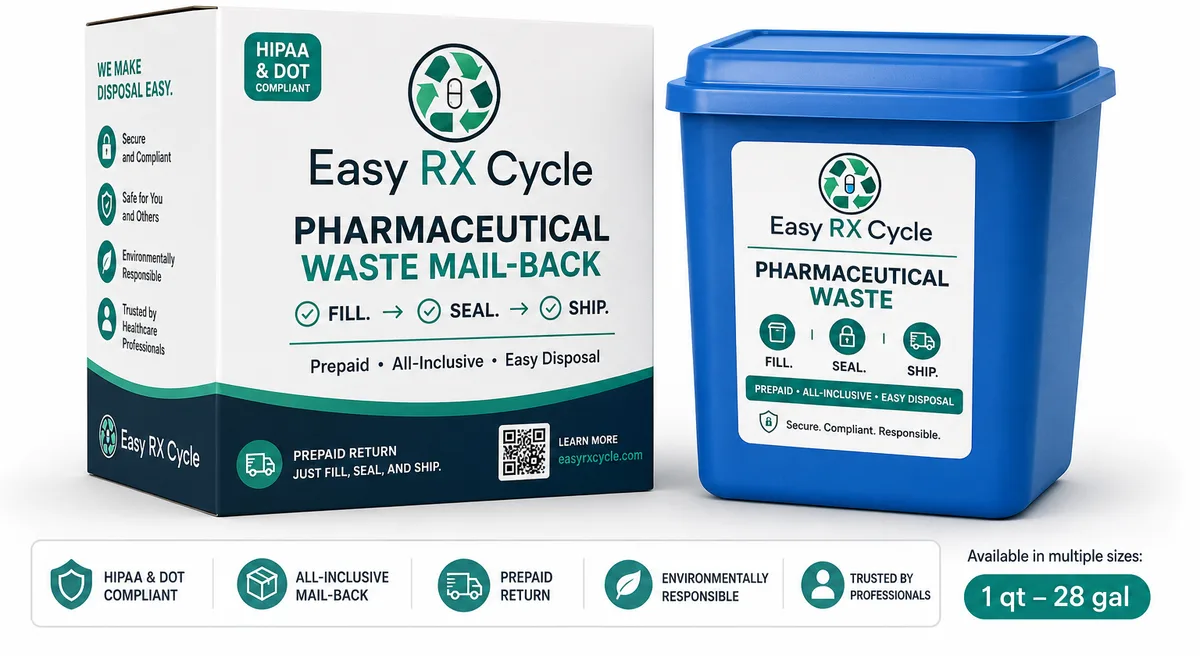
The full pharmacy waste stream.
Most medication waste isn’t one category — it’s three. We segregate and route each correctly.
- Non-controlled expired Rx
- Over-the-counter (OTC) meds
- Non-hazardous pharmaceuticals
- Compounding & prep waste
- Controlled meds (routed to CSD)
- RCRA-hazardous (routed to RCRA)
Three streams, one name.
Non-hazardous, RCRA-hazardous, and controlled drug waste — how to tell them apart at the point of generation and route each correctly.
Non-hazardous pharmaceutical waste
The largest stream — expired or unused drugs that are not RCRA-hazardous and not controlled.
- Most expired oral & injectable meds
- Non-controlled, non-hazardous drugs
- Manufacturer samples
- IV bags without hazardous drug
- RCRA P/U-listed or characteristic drugs
- Controlled substances
- Trace chemo waste
RCRA-hazardous drug waste
Drugs that meet an EPA hazardous-waste definition — P-listed, U-listed, or characteristic.
- P-listed (e.g. warfarin >0.3%, nicotine, epinephrine base)
- U-listed (many chemo agents, e.g. cyclophosphamide)
- Characteristic: ignitable, corrosive, toxic (D-codes)
- Non-hazardous drugs (own stream)
- Controlled substances (own path)
Controlled substances in the drug stream
Controls that turn up alongside pharmaceutical waste have their own rules.
- Expired/unused CII–CV drugs
- Wasted controlled doses
- Non-controlled pharmaceutical waste
- Hazardous drugs (segregate, may co-apply)
The Pharmaceutical Waste Disposal Guide
How to segregate non-hazardous, RCRA-hazardous, and controlled drug waste, why the drain is off-limits, and how to destroy each stream — plus a checklist and FAQ.
One intake. Correctly segregated.
Send it in
Mail-back kit or scheduled pickup for higher-volume pharmacies and facilities.
We segregate
Non-hazardous vs. RCRA-hazardous vs. controlled — each stream separated for the right process.
Destroy non-retrievable
Everything is rendered non-retrievable to DEA and EPA standards for its category.
Documentation
Certificate of Destruction — plus manifests for hazardous and Form 41 for controls.
Correct segregation
We keep RCRA-hazardous and controlled meds out of the wrong bin — the #1 compliance risk.
DEA & EPA compliant
Each stream handled to its own federal and state requirements.
Non-retrievable destruction
Meets the DEA non-retrievable standard for any controlled meds in the mix.
Documented every time
Certificate of Destruction plus the right manifests, archived to your account.
Pharmaceutical waste questions.
How should a pharmacy dispose of expired medications?
Expired medications must be segregated by type: non-hazardous pharmaceuticals, RCRA-hazardous drugs, and DEA-controlled substances each follow different disposal rules. We take a single intake, separate the streams, and destroy each to its correct standard with full documentation.
What’s the difference between pharmaceutical waste and hazardous waste?
Some pharmaceuticals are also RCRA-hazardous waste (P-listed, U-listed, or characteristic D-codes) and must be managed under EPA rules with manifests. Non-hazardous pharmaceutical waste follows separate handling. We identify and route both correctly.
Can you handle controlled substances too?
Yes. Any DEA-controlled medications in your waste are routed to our controlled substance destruction process, rendered non-retrievable, with DEA Form 41 handled.
Do you offer pickup or only mail-back?
Both. Lower-volume sites use prepaid mail-back kits; higher-volume pharmacies and facilities can schedule pickups. We’ll recommend the right fit for your volume.
Do I get proof of destruction?
Yes — a Certificate of Destruction on every order, plus hazardous-waste manifests and DEA Form 41 where applicable, all archived to your account.
Learn more about pharma waste.
Pharmaceutical waste management
The five types of drug waste and the rules for each.
Hazardous vs. non-hazardous
How to tell the two apart and segregate them.
Segregation guide
Which drug goes in which container.
RCRA Subpart P
P/U-listed drugs and the management standard.
Who regulates it
DEA, EPA, and OSHA — and what each covers.
Recover credit on expired drugs
Reverse distribution for returnable stock.
Pharmaceutical Waste Disposal in all 50 states.
Mail-back to any U.S. address and scheduled pickup nationwide — pick your state:
Clean up your medication waste.
Get a quote for compliant pharmaceutical waste disposal — segregated, destroyed, and documented.