
Trace chemotherapy waste disposal in North Carolina.
Compliant disposal of trace (RCRA-empty) chemotherapy waste for Charlotte, Raleigh, Greensboro, Durham and communities across North Carolina — empty vials and syringes, trace-contaminated PPE and IV sets — collected in yellow containers, incinerated, and documented. Bulk and P-listed chemo route to our RCRA hazardous stream.
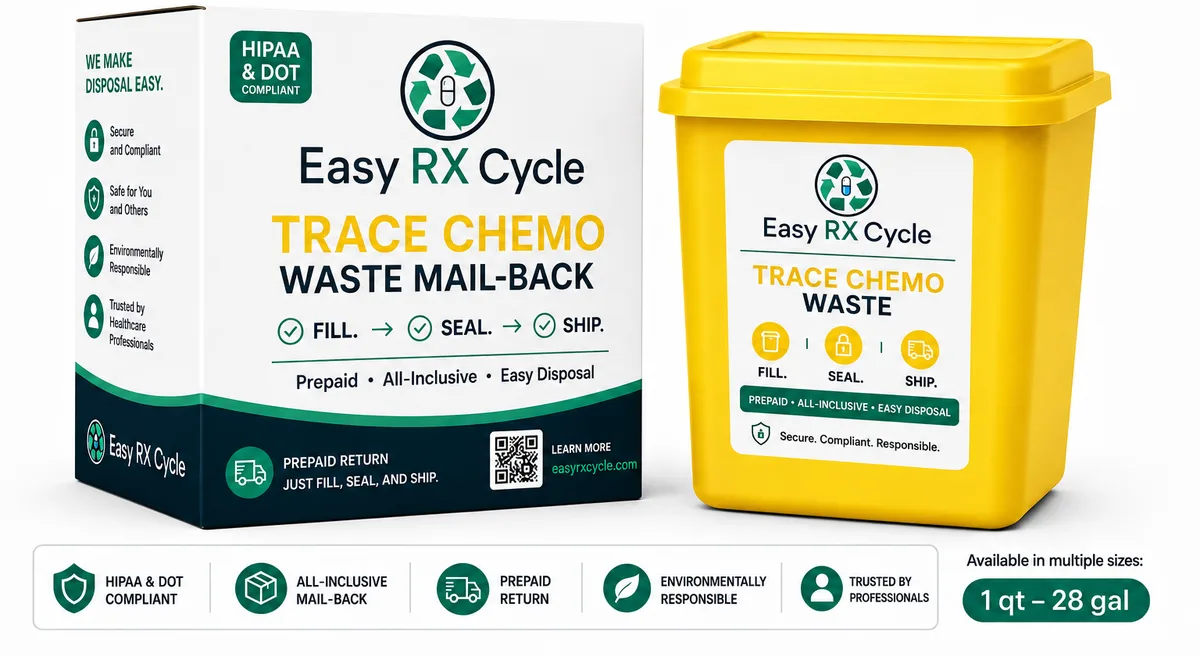
Every trace chemo item you generate in North Carolina.
RCRA-empty chemo waste, incinerated and documented.
- Empty (RCRA-empty) chemo vials & syringes
- Trace-contaminated PPE, gowns & gloves
- IV bags & tubing with trace residue
- Empty drug containers
- Contaminated prep materials
- Yellow-container trace waste
Pick a size. We handle the rest.
Prepaid, compliant, and documented — shipped to any North Carolina address.
Single-site practices and clinics in Charlotte with routine volume.
Higher-volume North Carolina sites — with an expedited option when timing matters.
Bulk volume, multi-site North Carolina programs, or scheduled pickup.
The Trace Chemotherapy Waste Guide
USP <800> handling, what makes waste “trace” vs. bulk (RCRA-hazardous), the yellow-container rule, and how any site disposes of trace chemo compliantly — plus a checklist and FAQ.
Mail-back or scheduled service, statewide in North Carolina.
Order your kit
Yellow trace-chemo container shipped to any North Carolina address with a prepaid return label — or set scheduled service for Charlotte and higher-volume sites.
Fill the yellow container
Place only trace (RCRA-empty) chemo waste in the yellow container — keep bulk/P-listed chemo in the RCRA stream.
Ship or pickup
Tracked door-to-door to our permitted facility under DOT rules.
Get documentation
Trace chemo is incinerated and your disposal record is archived to your account.
North Carolina & federal trace-chemo rules, handled.
Chemotherapy waste splits by how much drug remains. “Trace” waste — RCRA-empty containers and trace-contaminated materials — goes in yellow containers for incineration. Bulk or P-listed chemo (for example, discarded product or certain hazardous drugs) is a RCRA hazardous waste and must be managed as such. Federally, OSHA and USP General Chapter <800> govern safe handling of hazardous drugs, and the DOT governs transport. In North Carolina, the North Carolina Department of Environmental Quality (DEQ) and the North Carolina Board of Pharmacy add their requirements. Easy Rx Cycle sorts and routes each correctly, documented on every order.
- USP <800>: hazardous-drug handling & containment
- Trace vs. bulk: yellow-container trace incineration; bulk/P-listed routed to RCRA
- DOT: 49 CFR compliant packaging & prepaid return shipping
- North Carolina: state environmental & Board of Pharmacy requirements
- Environmental regulator
- North Carolina Department of Environmental Quality (DEQ)
- Pharmacy oversight
- North Carolina Board of Pharmacy
- Statewide drug take-back law
- No statewide take-back law — disposal via mail-back kits, pharmacy kiosks & DEA collectors
- Home sharps in household trash
- Allowed only in an approved, puncture-resistant container, subject to local rules
North Carolina healthcare footprint: roughly 1,507 pharmacies, 191 hospitals, 4,885 physician offices, 3,577 dental practices, 500nursing & long-term-care facilities, and 1,209 veterinary clinics — every one a generator of regulated waste we serve. Source: U.S. Census County Business Patterns, 2022.
Federal rules (OSHA 29 CFR 1910.1030, DOT 49 CFR, EPA RCRA, DEA 21 CFR 1317) apply in North Carolina on top of the above.
Built for North Carolina sites that handle hazardous drugs.
Trace Chemotherapy Waste Disposal in North Carolina: questions.
What is trace chemotherapy waste in North Carolina?
Trace chemo is RCRA-empty waste — vials and syringes emptied of drug, plus trace-contaminated PPE and IV sets. It goes in yellow containers for incineration. Bulk or P-listed chemo is a RCRA hazardous waste. We handle both across North Carolina, and serve Charlotte, Raleigh, Greensboro, Durham.
What's the difference between trace and bulk chemo waste?
“Trace” means the container is RCRA-empty (drug removed to the extent practical); it's incinerated as trace chemo. “Bulk” means usable or P-listed drug remains — that's a RCRA hazardous waste with stricter handling. Mixing them is a common North Carolina compliance error we help you avoid.
What color container does trace chemo go in?
Yellow. Yellow containers signal trace chemotherapy waste bound for incineration — separate from red (RMW), black (RCRA hazardous), and blue (pharmaceutical). Our North Carolina kits use the correct container for the stream.
Who regulates chemotherapy waste in North Carolina?
OSHA and USP <800> govern safe handling, the DOT governs transport, and the EPA's RCRA rules govern bulk/P-listed chemo. In North Carolina, the state environmental agency and Board of Pharmacy add requirements. We handle disposal to all of them.
Do you serve Charlotte and the rest of North Carolina?
Yes — mail-back reaches every ZIP in North Carolina, from Charlotte to Durham, and scheduled service is available for higher-volume sites across the state.
Handle trace chemo the compliant way in North Carolina.
Order a yellow-container kit in minutes, or get a same-day quote for scheduled service across North Carolina.