.png?width=5028&height=948&name=Group%202%20(5).png "Easy RX Cycle Logo")
How to Properly Destroy Controlled Drugs: DEA Forms 222, 41, and COD Explained
Controlled Drug Destruction: DEA Forms 222, 41, and Certificates of Destruction (COD)
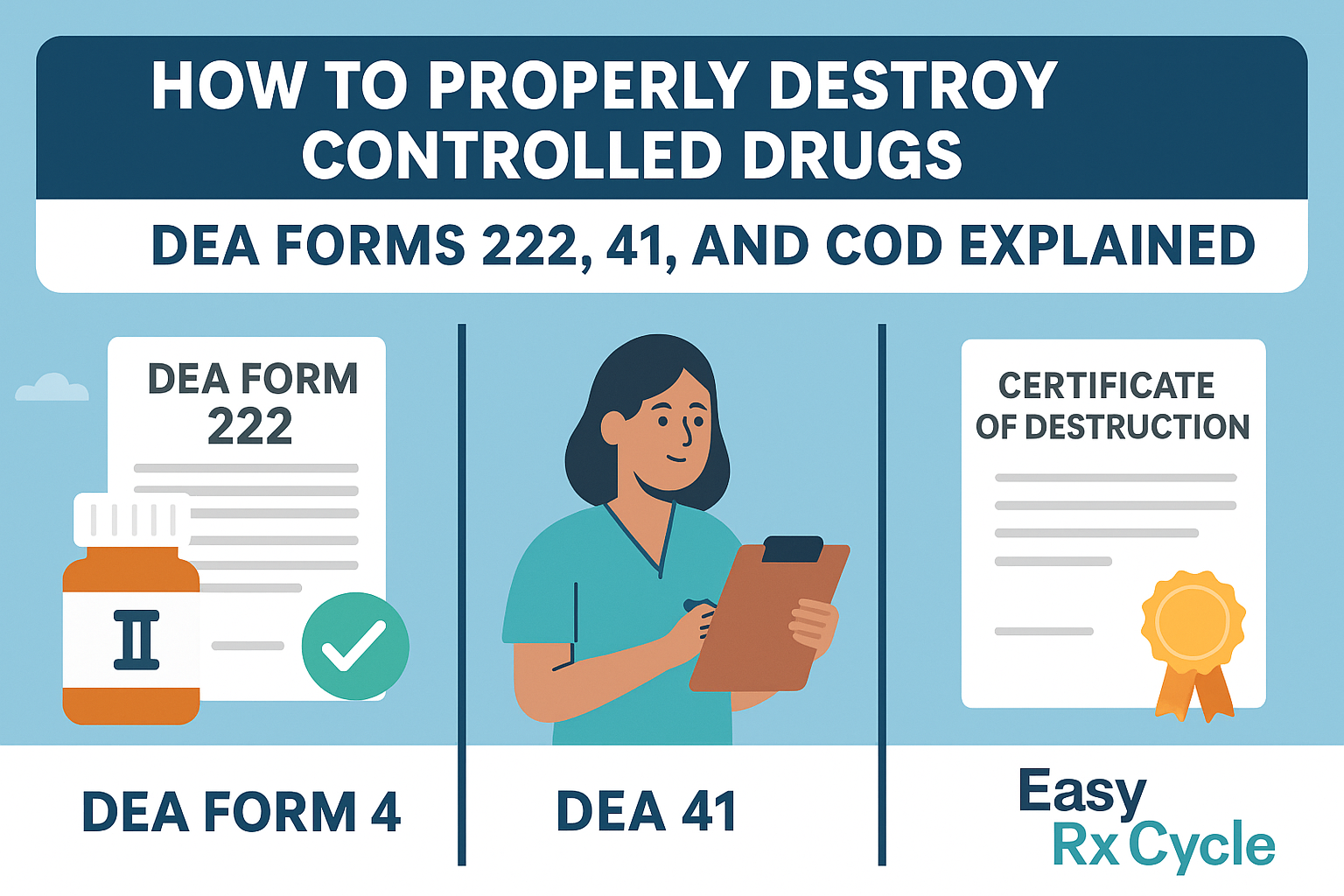
In the high-stakes world of pharmaceutical management, "Controlled Substance Disposal" is no longer a back-office chore—it is a critical compliance mandate. As the DEA ramps up its 2025 "Diversion Zero" initiatives, the margin for error has vanished. This guide provides an exhaustive breakdown of how to manage drug destruction, maintain the legal chain of custody, and protect your facility from the catastrophic fines associated with non-compliance.
To understand disposal, you must first understand the Controlled Substances Act (CSA). The DEA’s "Disposal of Controlled Substances" final rule (2014) fundamentally changed how registrants handle unwanted inventory.
The most significant hurdle in disposal is the Non-Retrievable Standard. Unlike non-controlled medications, which can often be neutralized with basic chemical kits, a controlled substance is only considered destroyed when it is rendered chemically and physically unusable. Request Quote Now!
Incineration: The gold standard. Large-scale thermal destruction at a permitted facility.
Chemical Digestion: Using activated carbon or specialized deactivation agents that bond to the drug molecules.
Prohibited Methods: You cannot simply "kitty litter" a Schedule II narcotic and throw it in the trash. This does not meet the "non-retrievable" threshold.
Looking for the Best Pharmaceutical Disposal Companies: Safe & DEA-Compliant?

If you are audited, the DEA won't ask to see your trash; they will ask to see your paperwork.
Any time a Schedule II substance moves, it must be tracked via DEA Form 222. If you are sending expired Oxycodone or Fentanyl to a reverse distributor, this form acts as the legal hand-off. Request Quote Now!
2025 Tip: Ensure you are using the single-sheet digital or paper format. The old "triplicate" forms are officially obsolete.
DEA Form 41 is your "Black Box" recorder. It documents the actual destruction event. It requires:
Inventory Details: NDC numbers, drug name, strength, and exact quantity.
The Method: You must state how it was destroyed (e.g., "On-site chemical deactivation followed by off-site incineration").
The Witnesses: Two authorized employees must sign off on the destruction.
While Form 41 is your record of starting the process, the COD is your proof that the process finished. This is issued by your waste partner (like Easy Rx Cycle) and is the final document required to "close the loop" in your inventory logs.
A 2,000-word guide must provide actionable value. Here is the recommended Standard Operating Procedure (SOP) for a high-volume facility. Request Quote Now!
Expired substances should never be left in the general inventory. They must be moved to a separately locked "Disposal Zone" within your vault. This zone must be clearly labeled and restricted to specific authorized personnel.
Before any destruction occurs, a pharmacist or authorized supervisor must reconcile the "Disposal Zone" inventory against the perpetual inventory log. Any discrepancy must be reported as a significant loss (DEA Form 106) immediately.
On-Site Deactivation: If using a deactivation system, two witnesses must observe the medication being placed into the solution.
Reverse Distribution: If shipping off-site, the two witnesses must observe the items being packed and sealed into the shipping container.
Federal law requires you to keep all disposal records for at least 2 years. However, due to state statutes of limitations, many compliance experts now recommend a 5-to-7-year retention policy. Request Quote Now!
Many controlled substances are also classified as Hazardous Waste under the EPA’s RCRA (Resource Conservation and Recovery Act). Request Quote Now!
P-Listed Waste: Extremely hazardous (e.g., Warfarin/Coumadin).
U-Listed Waste: Toxic chemicals (e.g., certain chemotherapy agents).
If a drug is both Controlled (DEA) and Hazardous (EPA), you must follow the more stringent of the two rules. This "Dual-Compliance" is where most facilities get hit with fines.
The Sewer Ban: As of August 2019, the EPA officially banned the "flushing" of pharmaceutical hazardous waste. In 2025, the penalties for "sewering" meds are higher than ever.
Trying to manage the intersection of DEA, EPA, and state laws in-house is a massive drain on resources and a huge liability. Easy Rx Cycle provides the specialized infrastructure to handle: Request Quote Now!
Reverse Distribution Coordination: We handle the Form 222 logistics.
EPA-Compliant Hauling: We ensure your hazardous waste doesn't end up in a standard landfill.
Verification: We provide the industry-standard Certificate of Destruction to protect you during audits.
Q: Can I use kitty litter for controlled substance disposal? A: No. Kitty litter and coffee grounds do not meet the DEA's "non-retrievable" standard for controlled substances.
Q: Who can witness a drug destruction? A: The DEA typically requires two authorized employees of the registrant. Some states require one witness to be a licensed pharmacist or a law enforcement officer.
Q: Do I need a Form 41 for every single pill? A: You need a record for every destruction event. While individual pills are listed, they are typically grouped by NDC number and strength. Request Quote Now!
Controlled substance disposal is about more than just "throwing things away." It is about protecting your DEA registration, your staff, and your community. By following the "Documentation Trinity" and partnering with experts, you turn a major liability into a seamless part of your operations.
Please note: If your facility uses a reverse distributor, the distributor may file the Form 41 on your behalf. However, you’re still responsible for recordkeeping. Got Questions? Request Help Now!
Controlled Drug Destruction: DEA Forms 222, 41, and Certificates of Destruction (COD)

 William Doxey : May 26, 2025 10:27:05 AM
What Is a Reverse Distributor? A reverse distributor is a DEA-registered company that helps healthcare facilities, pharmacies, and DEA registrants...
William Doxey : Sep 21, 2025 3:41:51 PM
What Is a Drug Disposal Company? A drug disposal company provides safe, compliant solutions for medication disposal and the handling of expired,...